
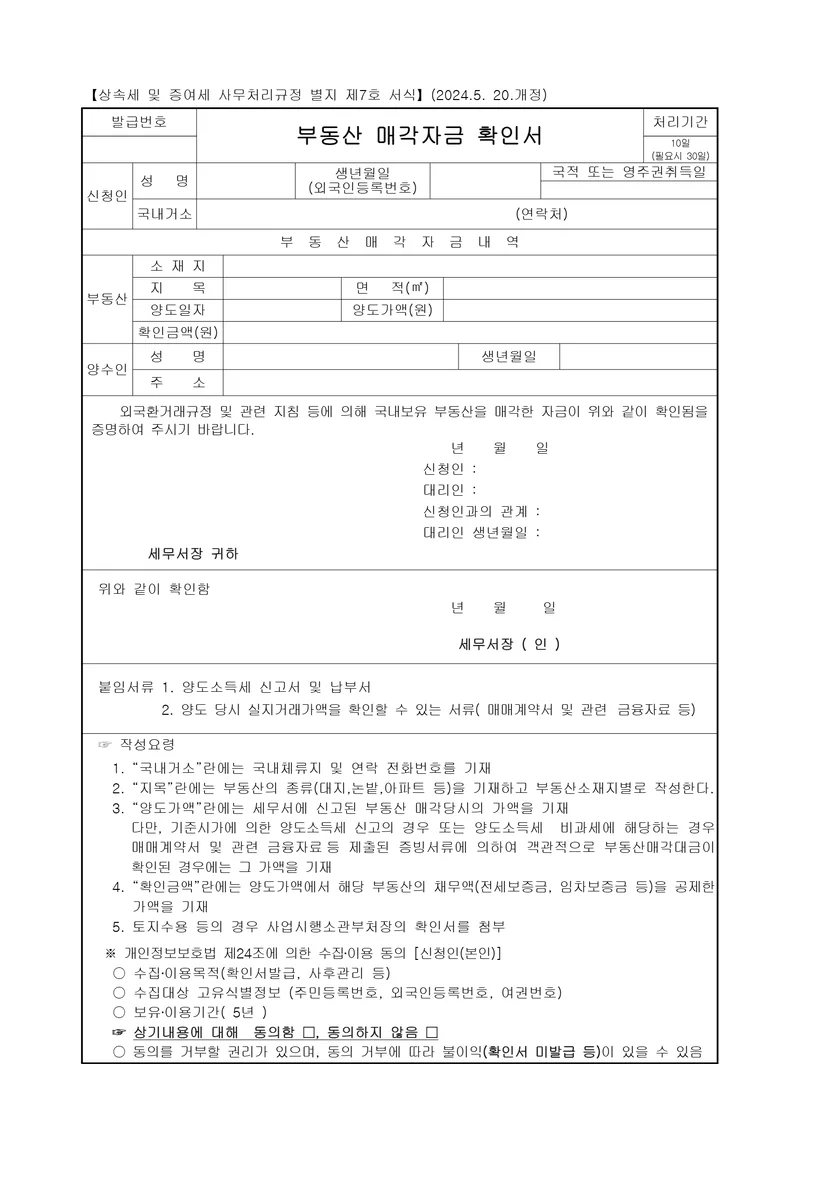
 Open full PDFNTS Form 7 (Rev. May 20, 2024)
Real Estate Sale Proceeds Confirmation (부동산 매각자금 확인서)
Required when wiring proceeds from selling Korean real estate. Attach the capital gains tax return/payment receipt and sale contract.
Home / English / Fund source confirmation
Overseas Koreans
In short Overseas Koreans who are non-residents can send Korean deposits, savings and returned lease deposits abroad up to the amount shown on a fund source confirmation (예금 등에 대한 자금출처 확인서) issued by a Korean tax office, through one bank they designate. The tax office issues it within 10 days of receiving the application (extendable once by up to 20 days) after checking that the related Korean taxes were filed and paid. Without it, a non-resident can send up to USD 50,000 a year.
Korean tax offices issue three similar certificates. Pick the one that matches where the money came from.
| Money you want to send | Certificate | Tax office | Rule |
|---|---|---|---|
| Bank deposits, savings, trusts, a returned lease deposit (jeonse or monthly rent deposit), KRW loans | Fund source confirmation for deposits (Form 12) | Location of designated bank, or last Korean address | NTS rules Art. 59 |
| Proceeds from selling Korean real estate | Real estate sale proceeds confirmation (Form 7) | Last Korean address, or location of the property | NTS rules Art. 58 |
| Money an emigrant takes when moving abroad | Emigration expenses fund source confirmation (Form 19) | Last Korean address | NTS rules Art. 57 |
For property sales, the amount you can take out is the actual sale price minus debts on the property (including tenant deposits), capital gains tax and local income tax, and selling costs (NTS rules Art. 58(4)). Selling property as a non-resident
The Foreign Exchange Transaction Regulation (Art. 1-2(29)) defines overseas Koreans as:
You must also be a non-resident under the Foreign Exchange Transactions Act. A Korean national staying abroad for 2 years or more is a non-resident, and short visits home of up to 3 months count toward those 2 years. A former non-resident who enters Korea and stays 3 months or longer is treated as a resident (Enforcement Decree Art. 10).
| Document | When |
|---|---|
| Statement of assets to be taken out | Always (attachment to the official form) |
| Copies of bank, savings or trust passbooks and papers showing where the deposits came from | Bank deposits |
| Loan account copy and loan documents | KRW loans |
| Copy of the lease contract | Returned lease deposits |
| Power of attorney | If an agent applies for you |
The form does not set a fixed number of years of transaction history. What matters is showing where large deposits came from, such as salary, severance pay or sale proceeds. Tax offices differ in what extra papers they ask for, so it helps to check with the officer before filing.
Review the actual National Tax Service (NTS) form layout below with an English field-by-field guide, and download the official PDF or editable HWPX file directly.
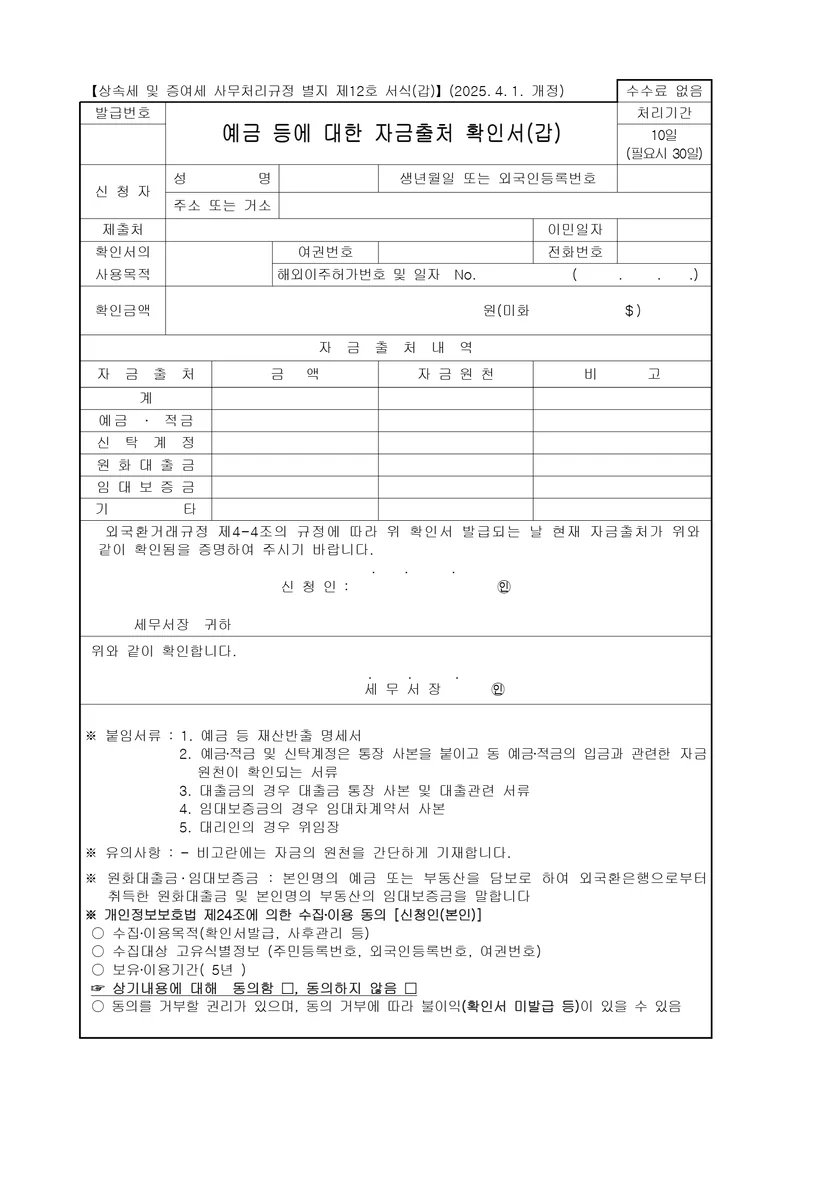 Click to open full official PDFOpen full PDFNTS Form 7 (Rev. May 20, 2024)
Required when wiring proceeds from selling Korean real estate. Attach the capital gains tax return/payment receipt and sale contract.
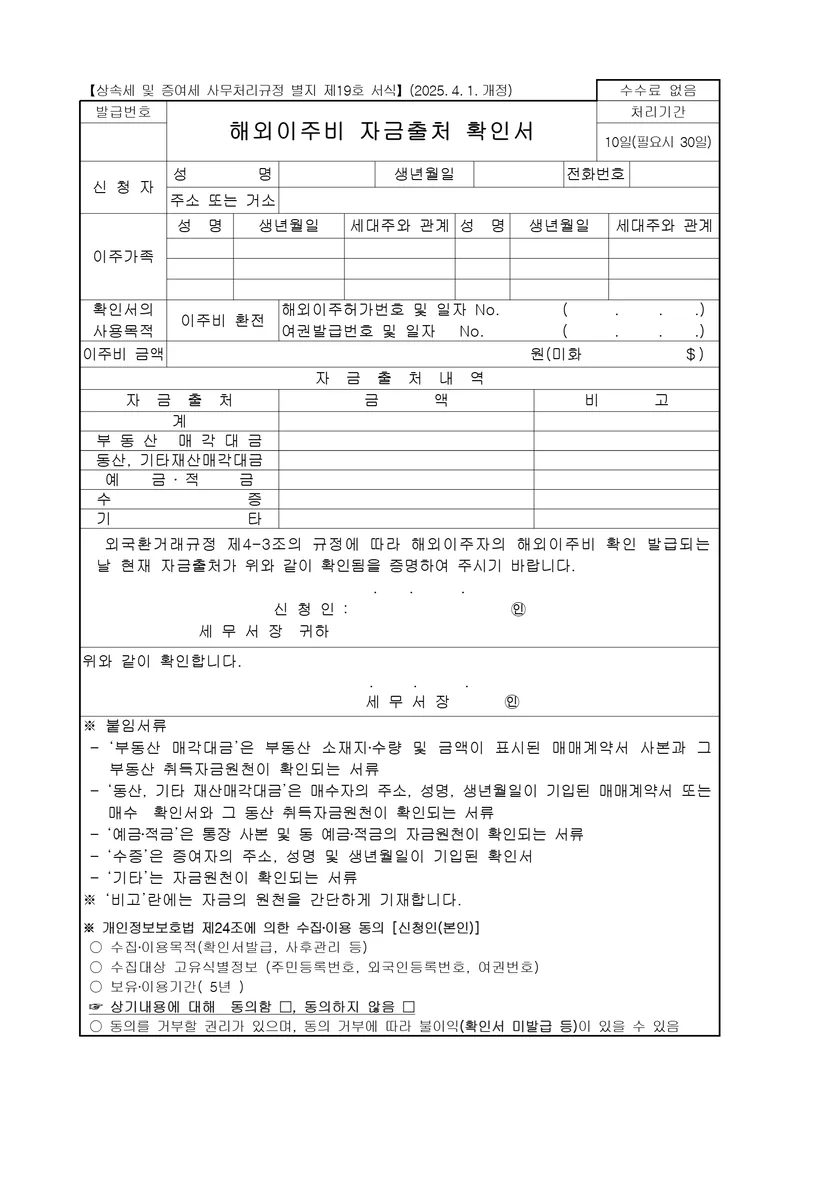 Open full PDFNTS Form 19 (Rev. Apr 1, 2025)
For Korean emigrants wiring emigration funds after filing an overseas emigration notice (Foreign Exchange Regulations Art. 4-3).
Source: Official administrative forms published by the National Law Information Center of Korea (law.go.kr), verified 2026-11-23. Attachments vary by source of funds and district tax office.
Before February 10, 2025, Article 4-7 of the Foreign Exchange Transaction Regulation had a separate procedure for overseas Koreans, built around a cumulative USD 100,000 threshold. That article was deleted on February 10, 2025. Now Article 4-4(1)8 allows a non-resident overseas Korean to send money within the amount of a real estate sale proceeds confirmation or a fund source confirmation through a designated bank. Many websites still describe the old rule.
| Who | Without a confirmation | Rule |
|---|---|---|
| Korean resident | Up to USD 100,000 a year without supporting documents | Regulation Art. 4-3(1)1 |
| Non-resident | Up to USD 50,000 a year through a designated bank or card company | Art. 4-4(2) |
| Non-resident overseas Korean | Beyond that, within the confirmed amount | Art. 4-4(1)8 |
| Emigrant | Emigration expenses within the confirmed amount, through a designated bank | Art. 4-3(1)9, 4-3(3) |
From the tax office covering the location of your designated foreign exchange bank or your last address in Korea. The property tax section handles it (NTS Inheritance and Gift Tax Administrative Rules Art. 59).
Within 10 days of filing. If the office needs more time to secure unpaid tax or review the case, it can extend once by up to 20 days.
No. The old cumulative USD 100,000 rule was deleted on February 10, 2025. Without a confirmation, a non-resident can send up to USD 50,000 a year; beyond that, overseas Koreans send within the confirmed amount.
Yes, through an agent. A power of attorney is one of the listed attachments. Check in advance what format the tax office and bank accept for a document signed abroad.
The Korean inheritance tax return and payment. The tax office checks that the taxes related to the money were filed and paid before issuing the confirmation.
Possibly not. A former non-resident who stays in Korea 3 months or more is treated as a resident under the foreign exchange rules, so ask the bank before applying.
Checked against the official Korean law database on 2026-11-22. General rules only; your nationality, stay records and where the money came from can change the answer.

Seojin Tax Corporation, Yeouido, Seoul. Registered tax accountant No. 9105103. I handle inheritance and capital gains tax returns and fund source confirmation applications in Korea for clients living abroad. About me
Email me the country you live in, your nationality or residency status, and where the money came from (deposits, inheritance, lease deposit). I reply within 24 hours and tell you which certificate you need and what it would cost before any work starts. Please do not send passport or full account numbers in the first email.
Seojin Tax Corporation Certified Tax Accountant Ryonggwon Lee (Reg. No. 9105103)
Business Reg. 107-87-78998, 501 Geumsan Bldg, 750 Gukhoe-daero, Yeongdeungpo-gu, Seoul, Korea